Explore the technologies, innovations, applications and engineering behind our solutions.
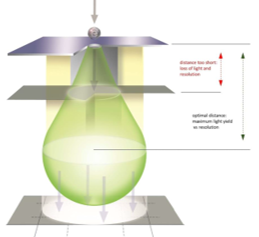
Why Tapered Fibre Coupling In Transmission Electron Microscopy (TEM), the quality of the final image depends not only on the CMOS sensor itself, but on how efficiently the electron image is transferred from the scintillator to the sensor. For bottom-mounted TEM cameras, tapered fibre-optic coupling provides an efficient and highly stable solution for matching these…
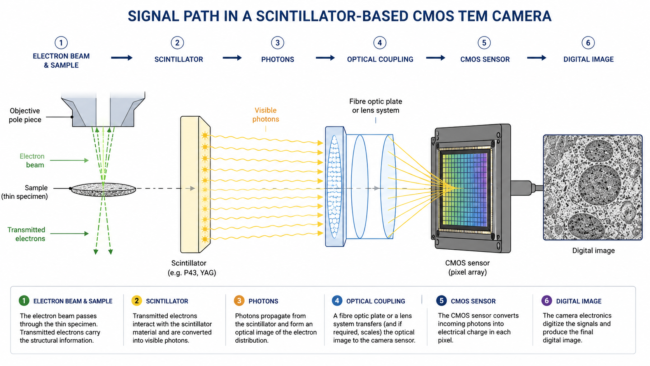
Converting an electron image into a digital image In Transmission Electron Microscopy (TEM), the sample is illuminated by a high-energy electron beam. As the electrons pass through sample, they are scattered, diffracted (according to the structure and composition of the sample) and the resulting electron distribution will be converted into a visible image can…
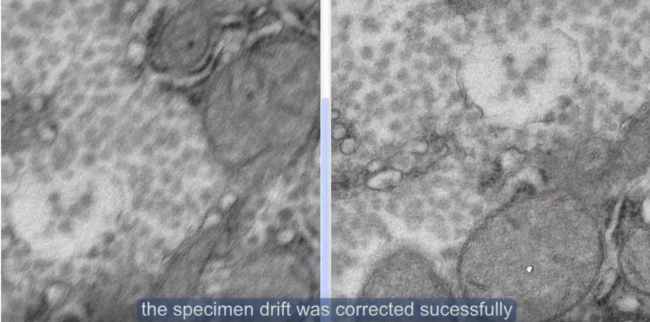
DRIFT IN TEM: CAUSES AND SOLUTIONS Drift in TEM refers to a continuous, slow, unidirectional or cyclical movement of the sample region within the field of view during observation or imaging. It severely degrades the quality of high-resolution imaging and spectroscopic analysis (e.g., EDS). Below are the main causes of drift and their corresponding…
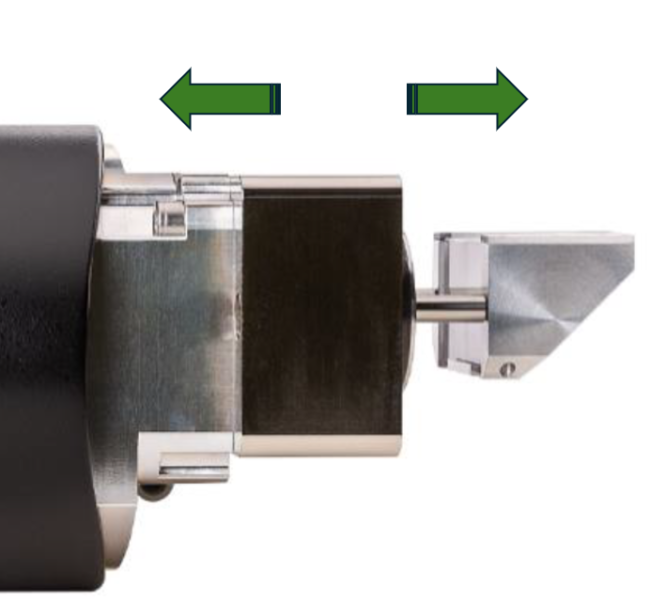
A smart approach to side-entry TEM imaging Side-mounted cameras are widely used in transmission electron microscopy (TEM) when a large field of view is required for specimen searching, navigation, overview imaging or diffraction. However, integrating a camera into the side-entry port presents a fundamental engineering challenge: the detector must be positioned accurately at the microscope’s…
Which Camera is Best suitable for my Application At EMSIS , our cameras are primarily used for Transmission Electron Microscopy (TEM) imaging in life sciences, materials science, semiconductor, diffraction, and dynamic/in-situ studies. EMSIS currently offers both bottom-mounted and side-entry cameras, with RADIUS software providing acquisition, image processing, and TEM control. Below we listed some…