A smart approach to side-entry TEM imaging
Side-mounted cameras are widely used in transmission electron microscopy (TEM) when a large field of view is required for specimen searching, navigation, overview imaging or diffraction. However, integrating a camera into the side-entry port presents a fundamental engineering challenge: the detector must be positioned accurately at the microscope’s electron beam path while remaining sufficiently compact and accessible outside the microscope column. EMSIS has developed a proprietary retractable, in-out camera movement technology to address this challenge. The camera can be moved between an imaging position inside the side-entry port and a retracted position outside the microscope, providing a highly practical combination of optical access, mechanical integration and operational flexibility.
How does the retractable concept work?
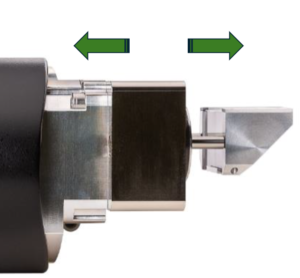
In an early generation fixed side-mounted camera, the detector and scintillator remain separately positioned at the microscope’s two side ports. The camera therefore occupies two ports continuously. With the EMSIS in-out concept, the camera assembly is designed to move along a controlled path between two defined positions:
IN – Imaging position:
The scintilaltor is inserted into the side-entry position and aligned with the TEM electron beam path for image acquisition.OUT – Retracted position:
The scintillator is withdrawn from the beam path, providing access to the side port while keeping the camera safely outside the high energy beam path.This apparently simple movement requires precise mechanical design. The camera must return reproducibly to its imaging position while maintaining the required optical alignment and mechanical stability.
What are the benefits?
The major advantage of the retractable concept is flexibility. A side-entry camera is often used as a complementary detector to a bottom-mounted camera. The side camera provides a large field of view and is particularly useful for specimen searching and navigation, while the bottom-mounted camera is typically used for high-resolution imaging. The EMSIS in-out approach allows the camera to be retracted when required, providing greater freedom around the microscope’s side-entry area. This can be particularly valuable on TEMs where space around the side ports is limited or where other accessories (e.g. STEM detectors) need access to the same area.
Movable optical-coupled cameras versus fixed fibre-coupled cameras
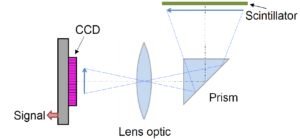
Some side-mounted TEM cameras use a fixed fibre-optic coupling between the scintillator and the sensor. Fibre coupling offers advantages, including a compact optical path and good mechanical stability. However, a fixed fibre-coupled camera generally takes more space and is restricted by the TEM side port size. The cooling of the sensor can also be risky for the camera, which may easily attract contamination. The EMSIS in-out concept takes a different approach: the camera and sensor stays out of the chamber but moves together with the scintillator. This provides a number of practical advantages:
- Retractable camera position when imaging is not required
- Improved access to the side-entry area
- Reduced obstruction around the microscope
- Repeatable return to the imaging position
- Convenient use as a complementary camera to a bottom-mounted detector
- Mechanical integration designed specifically around the TEM side-entry geometry
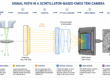
Additionally the EMSIS side mounted cameras are lens-based optical coupled In this architecture, the scintillator image is transferred through a customized lens system to the CMOS sensor. EMSIS uses customized lens optics in its MAKIYA and PHURONA side-entry cameras, designed for high light transmission with minimized distortion, reflections, chromatic aberration and vignetting.
The in-out concept addresses an additional aspect of the camera design and usage. Rather than relying solely on the optical coupling architecture, it focuses on how the complete detector assembly interacts mechanically with the microscope. This distinction is important: an in-out mechanism does not inherently replace fixed fibre-coupled cameras. It is an integration technology that can be combined with an appropriate optical detector design.
Designed for TEM workflows
A side-mounted camera is often most valuable during the early stages of an experiment: locating the specimen, navigating across a large area, selecting a region of interest and checking the overall sample. The key benefit of EMSIS’ proprietary in-out technology is therefore not simply image quality or camera speed. It is the integration of the camera with the TEM as a complete instrument.and it complements this functionality by making the camera mechanically adaptable to this workflow,
Both fibre-coupled and or lens-coupled side-mounted cameras can both be highly effective TEM imaging solutions. The EMSIS approach adds yet another dimension: controlled mechanical movement of the complete camera assembly. For TEM users, this can mean easier access, greater flexibility and a cleaner integration of side-entry imaging into the microscope workflow.
EMSIS ASIA
TEM CAMERAS

X
- No products in the list